From home energy audit to tailored report
Use the walkthrough and dashboard free. Pay only when you want the two PDF formats for this household.
01
Gather the details that matter
Start with location, approximate floor area, occupants, and the fuels used for heating, hot water, cooking and drying. Equipment labels and recent dated electricity bills are useful if you have them.
The time needed depends on the information you have ready. Allow time to check major equipment and usage; you can save your answers and come back.
02
Work through one topic at a time
The guided questions cover your home, equipment and operating habits. You can mark uncertainty instead of guessing, then review which unanswered details affect the estimate.
Choose the purpose of your estimate: understand bills, plan a new home, document consumption for solar planning, or explore changes.
03
Review the free dashboard
See annual electricity, its main drivers and the equipment behind the total. Review supported monthly detail and bill comparisons. Check warnings and retained assumptions before relying on a number.
Cost context uses the rate shown beside the estimate. Historical average or effective rates do not establish avoidable bill savings.
04
Compare changes before applying them
Try a specific EV charging pattern, load schedule, lighting change, thermostat setting or equipment replacement. A replacement identifies the equipment it displaces.
Compare multiple changes together because their effects can interact. Nothing is applied to your saved estimate until you choose to apply it.
05
Save a report when you are ready
For $19 once for this household, save both the full energy report and the concise consumption-planning report. They include the same totals, equipment, assumptions and existing-versus-planned load information.
Each saved version keeps its date, inputs and calculations. Download that version again, or save a new one after updating this household. Utility acceptance, PV sizing and professional review are not included.
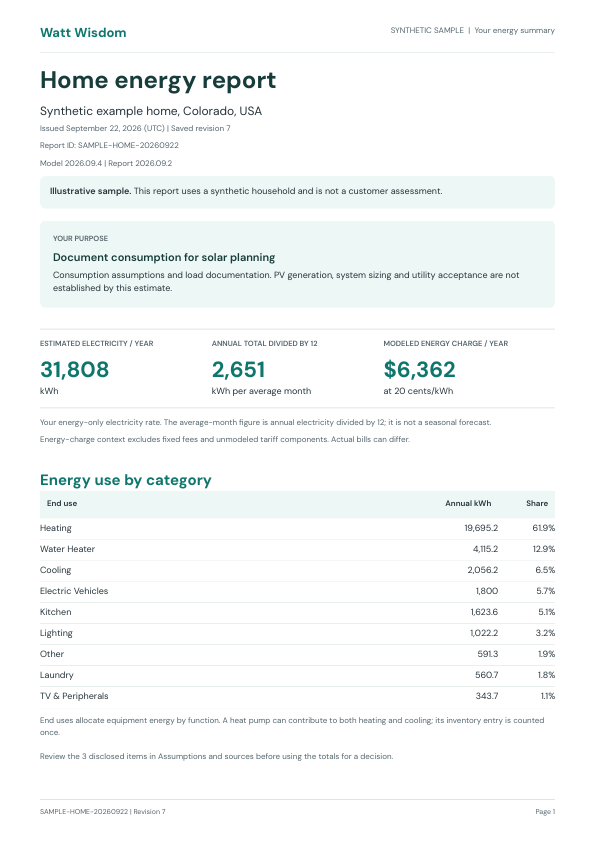
Synthetic example · page 1
Preview both report formats
These public samples use a synthetic example household. They do not contain your answers or a customer assessment.